Thalamus on a Pi
A small OpenClaw community plugin that swaps "paste the whole transcript when you spawn a sub-agent" for a 3-field packet reference resolved against a local vector store. Pi 5, MIT, on ClawHub and npm.
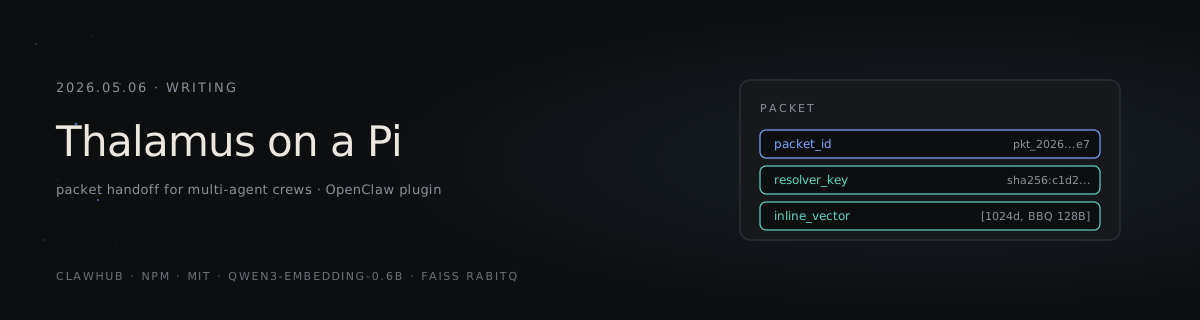
I shipped a thing called Thalamus last week. It is a community plugin for OpenClaw multi-agent crews. Instead of pasting the whole transcript when one agent spawns another, the spawning agent emits a 3-field reference and the receiver resolves the relevant atoms from a local vector store.
{
  packet_id:     pkt_2026...e7
  resolver_key:  sha256:c1d2...
  inline_vector: [1024d Qwen3-Embedding-0.6B, BBQ-128B compressed]
}
The MCP server lives in the upstream openclaw-thalamus npm package. The OpenClaw plugin shim that wires it up lives in openclaw-thalamus-plugin on ClawHub. Both are MIT.
What is in it
- Packet store with content-hash resolver keys
- Vector store with 9 namespaces (atoms.code, atoms.audit, atoms.plan, atoms.memory, atoms.audio.raw/text, atoms.image.raw/text, atoms.crossmodal)
- Encoder daemon: Qwen3-Embedding-0.6B Q4_0 GGUF on Pi 5 CPU via llama.cpp
- FAISS RaBitQ codebook compressing 1024-dim vectors to 128 bytes
- MCP server with six tools:
thalamus_route,thalamus_resolve,thalamus_search,thalamus_search_with_vector,thalamus_promote_packet,thalamus_telemetry - Optional Hailo HEFs for Whisper and CLIP encoders on the AI HAT
What is honestly measured
Direct measurements from the live Pi 5, paste-in verbatim from ~/.openclaw/thalamus/state/run_telemetry.jsonl:
- Protocol-level token compression: 19.1 percent reduction on Captain spawn context (
spawn_context_tokens68 tocompact_context_tokens55) across the three sample runs the file currently holds. - Qwen3 warm encode: about 167 ms p50 on Pi 5 CPU.
- BBQ codebook on 99,823 vectors (10 percent holdout): mean cosine 0.978, p10 0.985, p50 0.999. Trained in 17.6 minutes on a desktop with an RTX 3070; the Pi rebooted three times during the first attempt.
The combined “packet handoff plus protocol” figure that appears in earlier README drafts compares against a hypothetical naive transcript paste baseline I did not run side by side, so I treat it as a single-machine direction signal, not a benchmark. The 19.1 percent figure is the only end-to-end number with a real before-and-after on the same workload.
The raw paste-ins live in BENCHMARKS.md on the openclaw-thalamus repo.
What is not Hailo
Hailo HEFs are wired for Whisper-encoder, CLIP-text, CLIP-image. The Hailo10H is detected and the HEFs are on disk. The Qwen3 text embedding does not run on Hailo. LLM and embedding GGUFs cannot run on Hailo10H; the device is for the audio and image encoders. The text encoder stays on CPU via llama.cpp.
Install
openclaw plugins install clawhub:openclaw-thalamus-pluginThe shim auto-installs the upstream openclaw-thalamus npm package as a dependency. No --dangerously-force-unsafe-install flag needed.
After install, wire the MCP server in ~/.openclaw/openclaw.json:
{
  "mcpServers": [
    { "name": "thalamus", "command": "openclaw-thalamus-mcp" }
  ]
}
Restart the gateway: systemctl --user restart openclaw-gateway. The MCP tools should appear in the OpenClaw tool registry.
Asking for help
Single-developer numbers are not enough to claim anything portable. If anyone runs this on their own crew, I would like to see your before-and-after spawn-context counts. Especially if the protocol-level compression does not generalise, I want to know early.
Links
- GitHub: github.com/msbel5/openclaw-thalamus
- Plugin shim:
openclaw-thalamus-pluginon ClawHub - npm: npmjs.com/package/openclaw-thalamus