Nine years on GitHub, in one afternoon
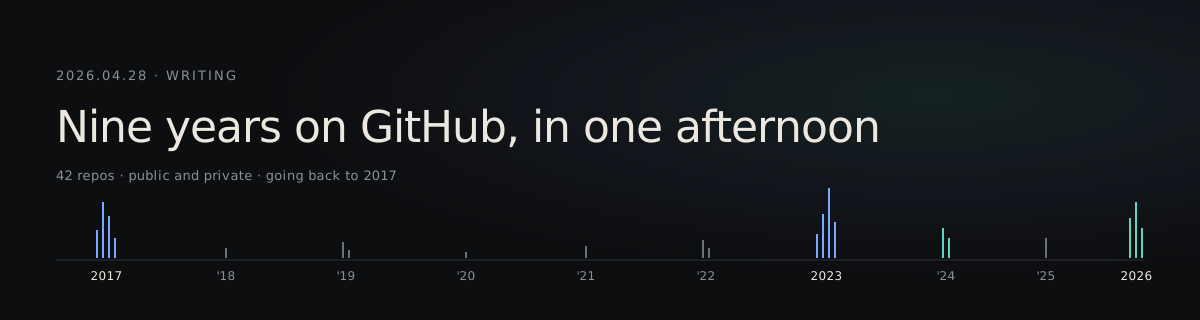
I cloned every repo I have ever pushed and looked at them in chronological order. The shape of a self-taught engineer learning to ship, in 42 commits-per-month bursts.
I cloned every repo on github.com/msbel5 to a single archive directory
this afternoon — 42 of them, public and private, going back to 2017 —
and read them in order. It was the kind of thing you do when someone
politely points out that your About page is too thin and you start
thinking, all right, what’s actually in the record?
Here is the record.
2017 — the burst
The first repo is FirstMVCBlog, September 2017. A blog engine written
while learning ASP.NET MVC. Crude, earnest, working.
Then on October 27, 2017, I pushed nine repos in a single day:
VeganCounter, TruvaTour, TourAutomation, LinqJsonExampleApp,
EntityFrameworkExampleAPP, UtilityBillsApplication,
HtmlJavascriptExample, plus CSharpDesignPatternExample and
AdoNetExample the day after. This is the shape of someone teaching
himself to ship — not waiting for a perfect repo, just pushing the
artefact and moving on.
HtmlJavascriptExample deserves a footnote: it’s a single-page HTML
serving multiple pages without frameworks, just JavaScript and AJAX. I
described it in the README as “expandable so data can be fetched with
ajax methods. Simple solution for serverless static pages.” That
instinct — static can do more than people think — has resurfaced in
every site I’ve built since, including this one.
2019 — Mahzenler ve Evrenler
MvE, “Dungeons and Universes”, is the earliest sign of the RPG
obsession that would surface every two years for the rest of my career.
A multi-project C# solution: BLL, DAL, UI, Tests, Tester. Naive
architecture. Right ambition. Every attempt I’ve made since —
DungeonsAndYou in 2023, ember-rpg in 2026, ember-crpg-unity last
month — has been an answer to questions this codebase asked.
2022-2023 — pivot to QA, pivot to scale
parking-lot and viewerTest (Java, 2022) mark the transition into
serious test automation. Then 2023 is a flood of QA tooling:
seleniumExample, apiExample, seleniumExamplev2 (a major Turkish
e-commerce site used as the test target), PostmanToCurl,
KarateToCurl, CodeGlimmer, HealthMonitorApp,
JavaFileConcatenator. Each one a small problem solved by writing the
tool I needed.
HealthMonitorApp (October 2023) is the first thing I built that I
still use. .NET 8 dashboard, OpenAPI ingestion, automated cURL
generation, custom assertions. The “$5/month app you don’t need to
pay for” thesis, in code form.
2024-01 — the agentic moment that didn’t land
This is the one that hurts a little.
In January 2024, I built dAIlog — a multi-agent ChatGPT framework on
top of AutoGen. C# / ASP.NET on top of a Python AutoGen service. A
single user prompt would spin up a multi-agent conversation. Agents
debated, decomposed, wrote code. It worked.
I proposed it as an internal product. It went nowhere internally.
Six months later “agentic” was the word everyone was using. Devin launched. Cursor exploded. Claude Code shipped. I had a working version of the same primitive sitting in a private repo from January.
I am not going to claim I was first. Plenty of people had similar things running at the same time; AutoGen itself was published. But I had it running — and I had the proposal rejected. The lesson was about distribution, not invention. The thing you build matters less than where you stand when you finish it.
2024-02 — traderBoy, and trading became a real interest
Flask front-end over a TA-Lib indicator engine. Side-by-side comparisons
of MACD, RSI, EMA crossovers. The first time I sat with the trading
problem long enough to understand why most retail bots lose money:
indicators are not signals, they are descriptions. This thread runs
straight through QuantumTrader (March 2024, C# WPF backtester) into
the current alcyone-trading-bot and its 9-layer signal stack.
2024-2025 — the private automation work
Six private repos in this period: a101ikwebautomation,
OrderAutomation, ozlukWebAutomation, hadiAutomation,
comisAutomation, Nop.Plugin.Payments.Iyzico. Client work,
e-commerce flows, payment integration. The discipline of writing test
automation that has to actually run against real e-commerce sites,
day after day, did more to sharpen my instincts than any amount of
clean greenfield code.
2025-06 — masterAutomation
A unified Selenium / Appium harness for web, Android, and iOS — single Java project, three runtime profiles. The locator JSON + step catalog pattern that became the blueprint for Pegasus a year later.
2026 — the fleet
ember-rpg, alcyone-trading-bot, pixel-agents-claude,
pi-tablet-bridge, ember-crpg-unity, ExampleBank_Test_Automation,
and finally msbel.com — this site, the umbrella. Six months. Seven
projects. The pattern is consistent:
- A real problem I had myself
- Built in public when possible (some things are still private)
- Self-hosted when the SaaS alternative wanted rent
- Released even when half-done, then iterated
Looking at the timeline
Reading nine years in one afternoon, the things that surprised me:
-
The continuity is hidden. Every project from 2017 onwards contains the seed of something I’d build seriously six years later. The HTML/JS single-page experiment in 2017 is the philosophy of this Astro site. The 2019 RPG is the heart of Ember. The 2023
seleniumExamplev2is the pattern Pegasus uses. -
The “agentic moment” was 2024-01, not 2024-09. I had a working multi-agent system before most of the discourse caught up. The lesson: have the demo and the distribution channel ready, or you are just an internal proposal.
-
The private repos are the most honest education. Public repositories perform; private client work teaches. Five years of shipping automation against e-commerce sites, payment flows, and real legacy systems is what makes Pegasus possible at all.
-
No commits between archived projects. The dead repos haven’t been touched. That’s actually a good sign — I’m not fake-committing to make graphs look green. If a repo is archived, it’s archived honestly.